Wednesday, December 7, 2011

Tax This, Tax That, Buyer Foot the Bill

Recall: New equilib emerges, price increases
-->why didn't go up to $4?
-Reduction in quantity
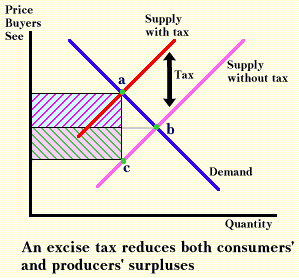
-Tax puts wedge btwn buyer value & seller cost
-Tax itself is just a transfer
Problem: distortionary, prevents other gain in society

Liability on sellers, but buyers pay 75 cents more

Current tax code is a mess, 51 pages to complete entire thing
Problem: people spend time & effort; Rizzo est. that he spend 15+ doing his taxes...ew
HUGE # of people to help with/process taxes (more than UPS, FedEx, Walmart & IBS combined!!)

Costs: could tax everyone, how spend tax revenue?
-build pointless bridges? bail out failed businesses?

Reasonable tax: divides $ appropriately
Problem: Fed uses taxes as excuse to spend more

New Sales Tax, Target the buyers!
Key Question:     What side of the market is affected?


Buyers
Sellers
Initial P
$3.00
$3.00
Final P
$2.75
$2.75
Tax Paid
$1.00
----
Burden
(Real Cost)
$0.75
$0.25


New Equilib: Qt= 275 mill
P buyers=$3.75  P sellers=$2.75
-Regardless who we ask to send a check same across! Whether sellers or buyers, the numbers are the same
-Policy makers have no control over "who eats it"
-Underlying economics forces buyers to pay most of the tax, even when target the sellers  (like last class)

ex: Payroll Tax
split 50/50, "share the burden" between the firm and the worker
-labor demand elasticity incredibly high
-higher worker costs, fire some of the work force
-worker always pays for the taxes in the end; lower tax, continue working; raise tax, lose job

Rizzo paid $37,800 in taxes...well I think I may stay in college for the next 20 years and avoid that nonsense

What determines who pays?


Buyers pay 75 cents, Sellers pay 25 cents
-Notice supply curve relatively flat  -->buyers pay big burden

Imagine: Flat Demand, sharp supply, ==>burden on the firms


Good Tax Policy: Not distortionary!
Supply/demand not elastic
-Efficient when tax property, cannot reduce demand when already live on plot of land
ex: Supply curve of oil inelastic
Consider: when make the firms pay, shareholders and customers really end up paying

Subsidy
-Any increase in demand/supply not soley...something
-Function of relative elasticity

ex: subsidize per gallon of ethanol produced
-prevent ..i was falling asleep
-force certain proportion
Consider graph in class:
At $300, S & D crossed at 1013; 
With subsidy, (new equilib)  cost $290 and supply 1113; at that quantity could have priced at $343
   ==>  43 / 53 = 80% customers...205?
What true in tax world same as subsidy! But here both buyer and seller better off

Tuesday, December 6, 2011

Some Have What It Takes To Make Their Own Success

I found this article both enlightening and encouraging. It shows that with the right attitude, determination and a bit of luck, someone could be a successful entrepreneur. If every person relied on stable businesses for jobs and benefits, it would certainly help the individual but the economy would become stagnant. Big business know to be wary of eager entrepreneurs because
  1) New start ups can replace other businesses in the coveted spot
     -they have incentives to harbor demand
  2) Big businesses' fear of failure leads them to use smaller businesses for services and to remain competitive.

The piece convinced of the importance of entrepreneurs because they respond better than other to market signals and have the power to abolish old, unsuccessful ideas and implement better practices. It is vital for an entrepreneur to be flexible and the ability to adjust to demands or unpredictable occurrences. My favorite part of the reading was that it is "easier to ask for forgiveness than for permission". To make it, one cannot be afraid of failure, authority or uncertainty. I think it is hard for economists and investors to give entrepreneurs the credit they deserve because many people look for the short term, monetary gains rather than the larger impact or long term benefits.

Monday, December 5, 2011

Tsk Tsk Taxes

Recall: Problems with current drug prohibition
-$$ to enforce
-keeps police from doing other, more productive things
-->large bureaucracies are resistant to change; U.S. prison system the largest in the world
-->U.S. spends $33 bill, arrest 1.5 mill people annually to enforce the drug prohibition
-Lots of effort, yet drug use continues

If drug prices had risen? Real price to end user has actually fallen in past decades
-Drug interactions have strong correlation w/ violent crime rate and drug law enforcement
-elim drug prohibition, would reduce the drug homicide rate
ex: 40,000 deaths in Mexican drug war
  -people kill each other to get demand
  -cross border violence

ex: California's 3 strike law: 3 chances to be caught with marijuana then get 15-20 years in prison
-Completely reduces marginal cost of beating up/killing someone who know to 0
-cost isn't higher b/c end up in prison if knowledge of substance and you get out
-->lowered marginal cost of committing the next worst crime, already going to jail

Why drug law came into being when they did?
-recession, depression, prohibition happens when economy bad?

ex: Before 1930, no outright call for the replacement of the 18th Amendment.
How did it gain momentum?
Great Depression, ruined the federal tax income
Prior to 1913, 1/3 of gov't revenue came from liquor tax
-1920, income tax brought in more $ so Congress could allow temperance movement
--> $$ important!!!
-1930, income tax plummeted, awful recession
-Used liquor sales in 1934 to raise revenues

Economic Incidence of Supply & Demand
Application: Taxation
Consider: Odd, tax not benefit or cost, it is merely a transaction; doesn't help or hurt
-taxes just transfer
-$ to gov't a benefit? only good if dollars spend well

Excise Tax: legal liability for a tax is on the seller
-the seller has to write the check to the gov't
-customers not liable

Example: tax on millions of packs of bubblegum


Initial Equilib: P* = $3

After Tax:
P buyers =$3.75
P sellers = $2.75
Qt = 2.75 mill, Taxes $2.75 mill


Buyers
Sellers
Initial P
$3.00
$3.00
Final P
$3.75
$3.75
Tax Paid
---
$1.00 ->$2.75
Economic Burden
75 cents
?


-Tax is one suppliers, tax affects the supply curve, $1 per pack 
-->shift supply curve UP by amount of the tax
-new equilib of 9

Notice, tax increased by $1, BUT
1st Result: price doesn't incr. by the amount of the tax
  -price went up 75 cents

2nd Result: How much $ raised by the gov't?
Wanted $3 mill, but generated $2.75 mill

Why Does This Happen?
Drives a wedge btwn buyers & sellers
-prevented other good transactions
-tax gets in the way; use $1 to gain 70 cents
--> tax greater than the value of the transaction, transfer won't happen

Problems with taxes:
-less wealth, fewer jobs, less businesses
-value of forgone transaction that would have happened absent of the tax
-bad if tax inefficiently

Cost resources to collect taxes
-Pay for peopel who administer, monitor & process the tax
-spend 41 cent per $100 tax collected to have the IRS, 115,000 people producing nothing of value
-dead weight separate from fraud  

Fraud: cheat on taxes, spend resources trying to cheat than doing something beneficial

Saturday, December 3, 2011

School Lunch

While Rizzo has convinced me that rent control causes more financial problems than housing help, I'm not completely sure I believe that price ceilings are worth completely abolishing. In lecture, I couldn't help but this of the cap on the price of school lunches. Maybe the people who want the nice penthouses or the tiny hole-in-the-wall apartments should get them because of ability to and value, but I believe education is a right of children in America, and they should not feel isolated or penalized by an expensive meal in the school cafeteria. I think the costs incurred by capping the price of school lunches are worth the other benefits gained from students. Cheap, unhealthy food can lead to high costs on health care (obesity is quickly becoming a major cost for Americans in the billions of dollars in medical visits). Also, food allows children to gain the nutrition and energy they need to focus in class; a hungry student may struggle and fall behind his peers in academic performance. It's like we learned in class, regulation should not be the goal, but sometimes it is necessary. When it comes to our kids, I think this is a practice worth keeping.

The Use of Knowledge in Society

Hayek's article articulates many considerations regarding who does the economic planning. With competition, there is decentralized planning done by separate persons. Hayek explains that knowledge is spread amongst several individuals; this is to the organization's benefit because each person possesses something unique (this reminds me of the Chuck Palaniuk quote "Nothing of me is original. I am the combined effort of everybody I've ever known" or rather that we are the sum of all of our experiences)

I agree with the idea that no one can possibly possess all the experiences, ideas or connections that I have accrued in my lifetime. There will come a time when I will have something to offer that no one else can give; perhaps it is a skill or a lesson from a previous mistake, but it will lead to some sort of benefit or advantage in the future.

I like Hayek's quote:
"To gain an advantage from better knowledge of facilities of communication or transport is sometimes regarded as almost dishonest, although it is quite as important that society make use of the best opportunities in this respect as using the latest scientific discoveries".

Success according to Hayek comes from the ability to adjust and reform in a strategic and effective manner. We should be open to all possibilities and insight from others. Decentralization is the solution to many economic problems because it solves the "knowledge problem" and also feedback, cooperation and even competition to bring out the best performance and product that can be provided.
Problems with Price Ceilings:
The main problem that price ceilings cause is SHORTAGE. Less people are willing to sell but more people are willing to buy. The price cannot bounce back to equilibrium.

It is not a landlord’s moral obligation to keep prices down so they are affordable. If this is the case, why isn’t it everyone’s moral obligation to provide housing? Why is it just the landlord’s

Price ceilings are intended to serve the poor/middle class who are unable to afford housing, but they
Actually more costly that price ceilings are enacted because they cause:
-Enforcement and policing (regulation is a cost)
-Bribery
-Inequity
-low-quality housing
-facilitators (apartment brokers)
-discrimination

The minimum wage reduced the demand firms have for workers. With higher wages, firms will respond ON SAME MARGIN to fix it.

Drugs and Illegal things
Rarity vs. Scarcity
What is the difference between rarity and scarcity? If something is rare, is it scarce?
Rizzo’s engagement ring: It is the only ring of its kind (with Rizzo’s initials and his wife’s initials). It is RARE but it is not scarce.
Water: Water is not rare but it is very scarce
Therefore, rarity and scarcity are different in that rarity is absolutely little in quantity whereas scarcity is when there is NOT ENOUGH of a good (even if it is abundant).

Surplus vs. Scarcity
If there is a surplus of something, can it be scarce?
If there is a surplus of a certain good, the quantity can be scarce because it means you are making a tradeoff. Remember the definition of scarcity since the 1st week of class: things are scarce because you have must forgo one good to get another good. 

ex: You will LOSE marginal benefits, like benefits. Benefits are not included in your wages so with higher wages, firms may take away your benefits.

What are better alternatives to minimum wage?
-Earned income credit 
What matters most is that people are not excluded from the market.
Why do unions support minimum wages?

Wednesday, November 30, 2011

The Economics of Price Controls

Rent= payment for  the use of capital, something that acrues to you without doing productive activities
(Idea, tax rent b/c not doing anything, don't tax work, we want people to work)

Market Equilibrium: P* = $1,000, Q*=12,000
Controlled Equilib: P (with price ceiling) = $800. Qd=14,000 Qs=10,000

If dictate lower prices, less suppply
-->landlords can only charge $800, the quantity supplied is lower
Consider the costs to deliver, some space becomes coops, offices buisness
-Quantity supplied falls by 2,000

Long run, supply of apartments elastic, able to adjust the number of rooms, wallls
Price lowered does NOT change demand
BUT the quantity demanded increases
-People decide to share apartment, live at home,

Ceiling: price doesn't change
-creates new equilibrium, controlled equilibrium
-->shortage of 4,000

"Price ceiling is binding" ->set price control below price that would have prevailed in the market
(Not binding means above market price)

Why equilib?
Buyers/sellers cannot do something better
-->sellers' plan satisfied, buyers plan not satisfied

Consider: less apartments than before price control!
w/out control, buyers can bid up the price

At price of $800, are apartments less scarce?
Depends why the price fell.
If legislated price, unclear

Consequences of Rent Control
1) Reduced availability & harder to get
-Some other cost will arise
Qd = Qs = 10,000, want to reach equilib. demanders find way to get

ex: wait in long lines to get gas, drive around to find shortest line
all things incr. the cost of obtaining beyond the sticker price

2) Lower Quality Apartment
-Leaky pipe kept leaking; if you don't like, plenty of other people ready to buy that apartment
-Cost $ to fix it, & cannot charge more for rent, cannot afford repairs

3) Other $ Will Be Paid, Black Markets
-Customers willing to pay more than $800, landlords may charge "finders fee"
ex: apartment brokers find apartments for you, illegal bribes/kickbacks

4) Misallocations
10,000/14,000 = 5/7
-People who value the thing the most may not get it
-Live w/ annoying roommate, can't move out b/c hard to find apartment 
Sublet: cheaper to keep large apartment, sublet rooms but gains do not reach the landlord

5) Other Markets
More expensive to live in the city, now more expensive to sprawl, AND incr. $ to transportation

6) Fairness
Who's able to pay

7) Discrimination 
Cost of discrim. reduced, don't allow market to work, don't face costs
-Age, size of people, sexual pref. race, don't allow market to work, don't face the cost 
-Without rent control and don't lease out, lose the $ of those people
-point of market clearing means no line to fill up
-BUT with rent control, don't lost $, plenty of people will find you

By being landlord, make room available to somebody, does some social if does discrim a bit
Consider: Buyers can be discriminating too

8) Monitoring/Enforcing Costs
-Costly to review boards, undercover agents
1. Reduce incentives; supply curve shifts in, flatter
2. Monitoring destructive
  -People/Resources not producing goods/services we want
  -example of broken window fallacy, wasteful practice
-->world without rape, fighting etc. there is no need for cops
-Right kind of regulation yes, but goal should not be regulation
3. Even if police do good job, (ignore waste) have to raise taxes to fund; taxes costly on consumers and to collect